Are you struggling to figure out how much food you need to get 30 grams of carbohydrates? Whether you’re gearing up for a workout or recovering afterwards, knowing the right carbohydrate portions is key to fuelling your body effectively.
This post will cover everything you need about portioning your food to hit that 30-gram target. By the end, you’ll understand how many carbohydrates are in your food or how to portion your food to meet the carbohydrate requirement, helping you properly fuel your workouts and recovery.
Table of Contents
How Much Food Equals 30 Grams of Carbohydrates?
To ensure you’re getting the correct amount of carbohydrates, it is important to know which foods contain carbohydrates and how much to consume to hit your target of 30 grams.
Let’s look at some carbohydrate-containing foods and how much of these foods equals 30 grams of carbohydrates. These quantities provide a practical starting point to gauge your carbohydrate intake.
In the table below, I’ve listed some common carbohydrate-containing foods and shown what portion size of each will provide 30 grams of carbohydrates.
Portion Size Of Foods Containing 30 Grams Of Carbohydrates
| Food | Portion Size (g/ oz) | Portion Size |
|---|---|---|
| Grains & pasta | ||
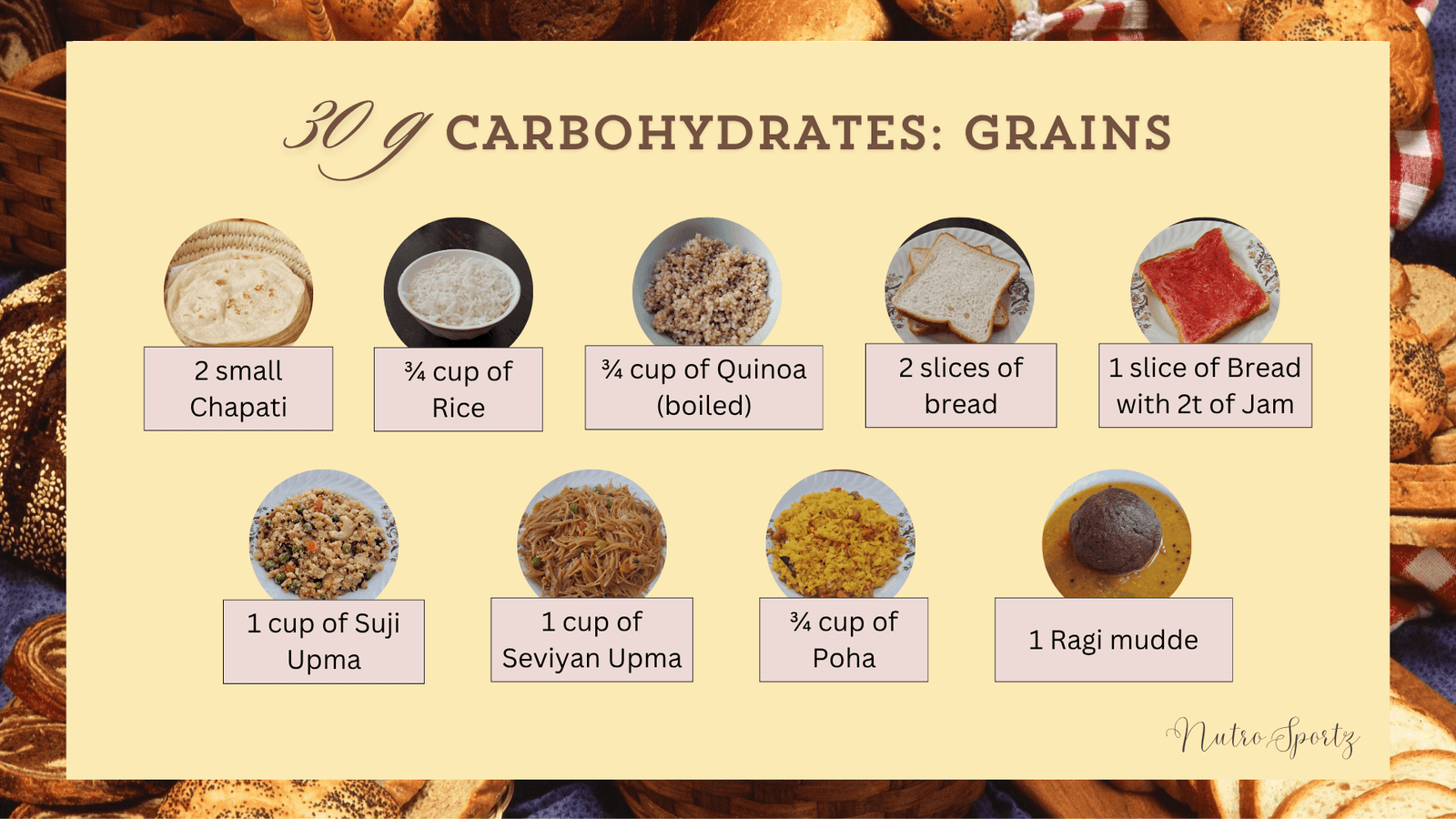
| Chapati (small) | Each chapati of 33 g/ 1.2 oz | 2 no. |
| Rice (cooked) | 120 g/ 4.2 oz | ¾ cup |
| Quinoa (boiled) | 130 g/ 4.6 oz | ¾ cup |
| Bread | Each slice of 27 g/ 0.95 oz | 2 slices |
| Bread with jam | 1 bread slice with 2 t jam | |
| Suji upma | 220 g/ 7.76 oz | 1 cup |
| Seviyan upma | 190 g/ 6.7 oz | 1 cup |
| Poha | 110 g/ 3.9 oz | ¾ cup |
| Ragi balls or mudde | Each mudde of 122 g/ 4.3 oz | 1 no. |
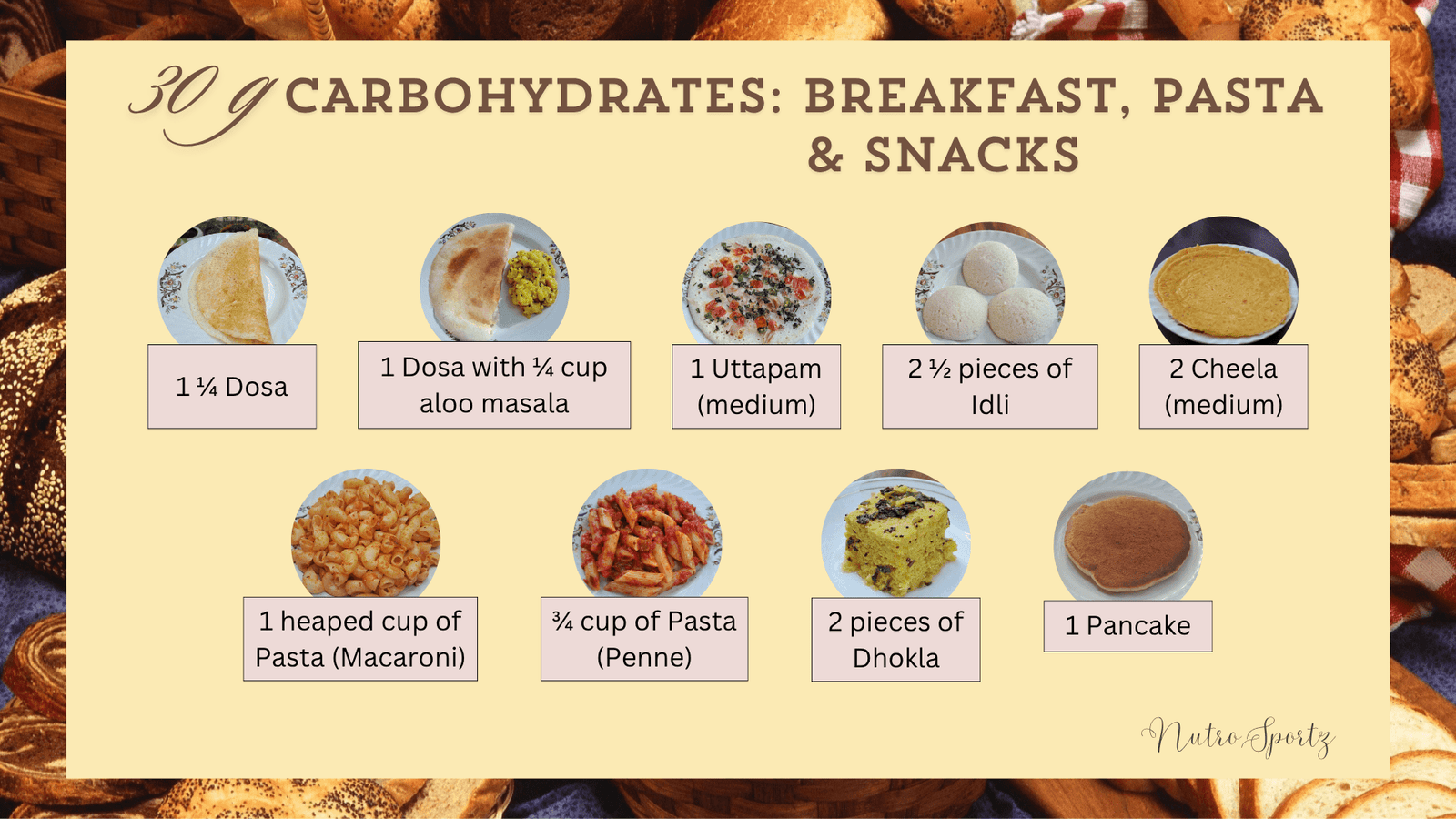
| Pasta (Macaroni) | 170 g/ 6.0 oz | 1 heaped cup |
| Pasta (Penne) | 135 g/ 4.76 oz | ¾ cup |
| Breakfast & Snacks | ||
| Dosa | Each dosa of 44 g/ 1.55 oz | 1 ¼ no. |
| Dosa with masala | 1 dosa with ¼ cup masala | |
| Uttapam (medium) | Each uttapam of 94 g/ 3.3 oz | 1 no. |
| Idli (medium) | Each idli of 40 g/ 1.4 oz | 2 ½ no. |
| Cheela (medium) | Each cheela of 40 g/ 1.4 oz | 2 no. |
| Dhokla | Each dhokla of 55 g/ 1.9 oz | 2 no. |
| Pancake | Each pancake of 55 g/ 1.9 oz | 1 no. |
| Breakfast cereals & porridge | ||
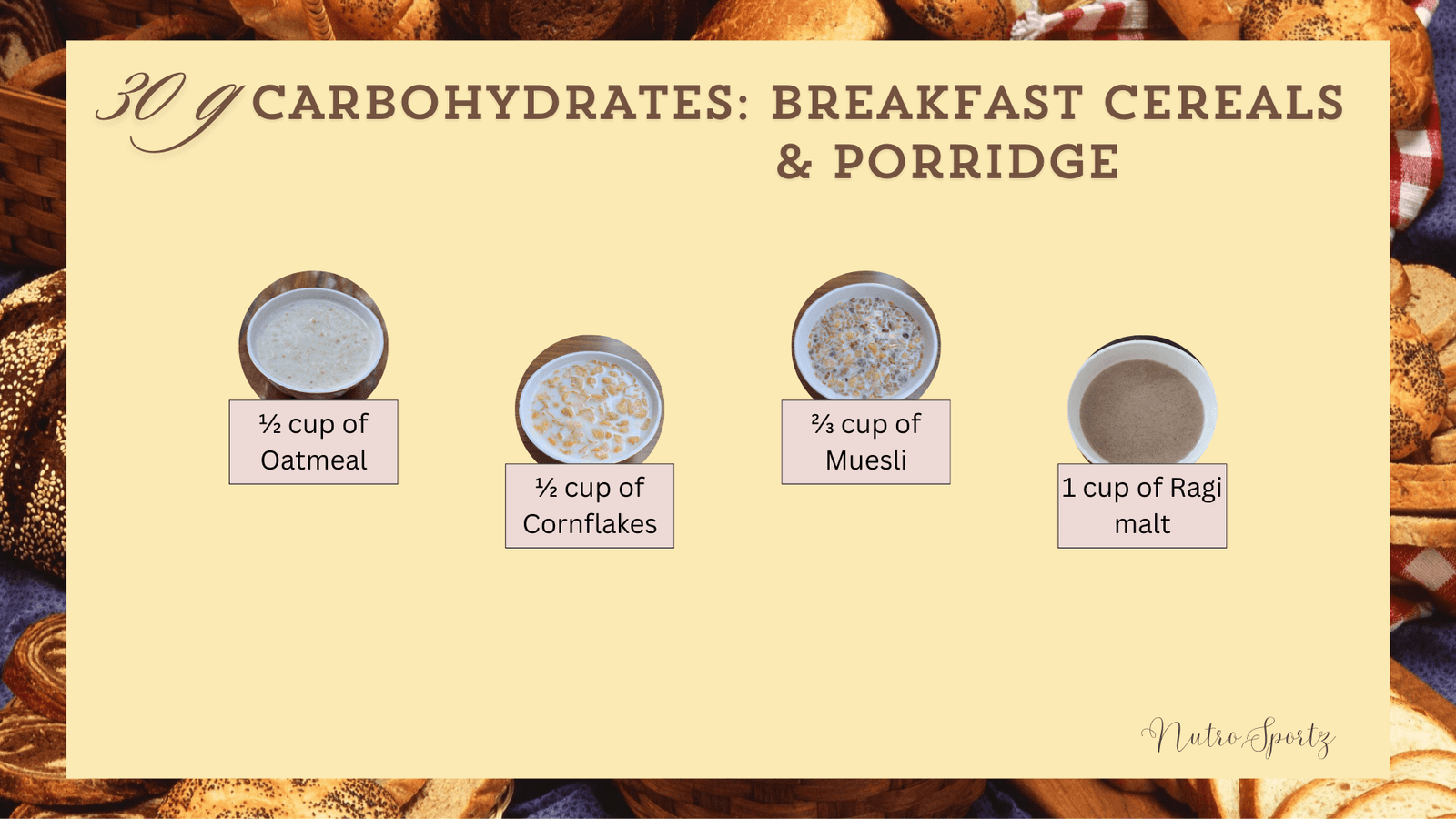
| Oatmeal | 135 g/ 4.76 oz | ½ cup (½ cup milk, 2 T oats, 1 t sugar) |
| Cornflakes | 135 g/ 4.76 oz | ½ cup (½ cup milk, 3 T cornflakes, 1 t sugar) |
| Muesli | 150 g/ 5.3 oz | ½ cup (½ cup milk, 3 T muesli, ½ t sugar) |
| Ragi malt | 220 g/ 7.76 oz | 1 cup |
| Pulses & Legumes | ||
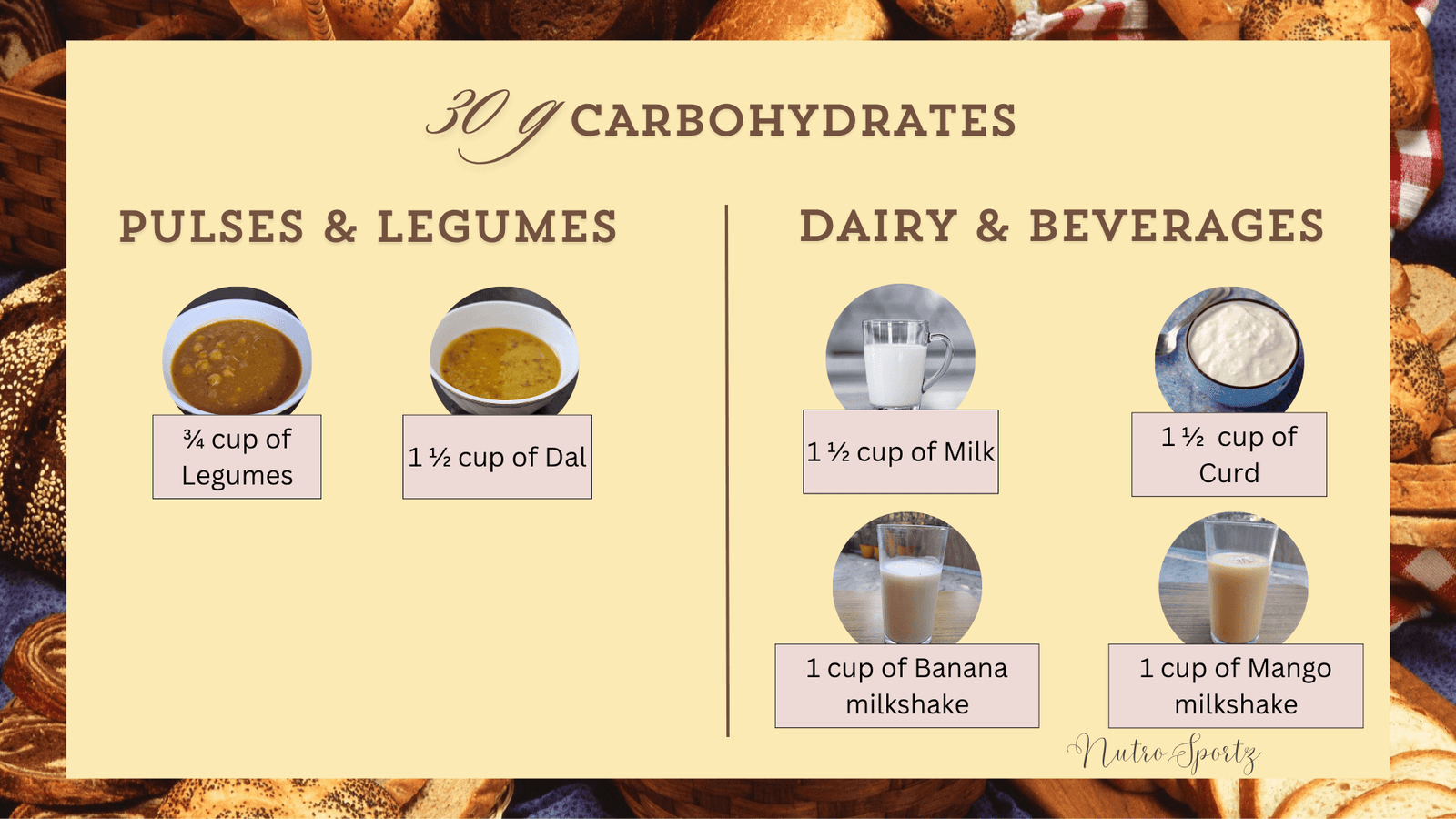
| Dal | 390 g/ 13.75 oz | 1½ cup |
| Legumes(rajma, chole, kala chana) | 200 g/ 7.05 oz | ¾ cup |
| Dairy & Beverages | ||
| Milk | 360 ml | 1 ½ cup |
| Curd | 360 g/ 12.7 oz | 1 ½ cup |
| Banana milkshake | 230 ml | 1 cup (¾ cup milk, ½ banana, 1½ t sugar) |
| Mango milkshake | 250 ml | 1 cup (¾ cup milk, 100 g mango, 1½ t sugar) |
| Dried fruits | ||
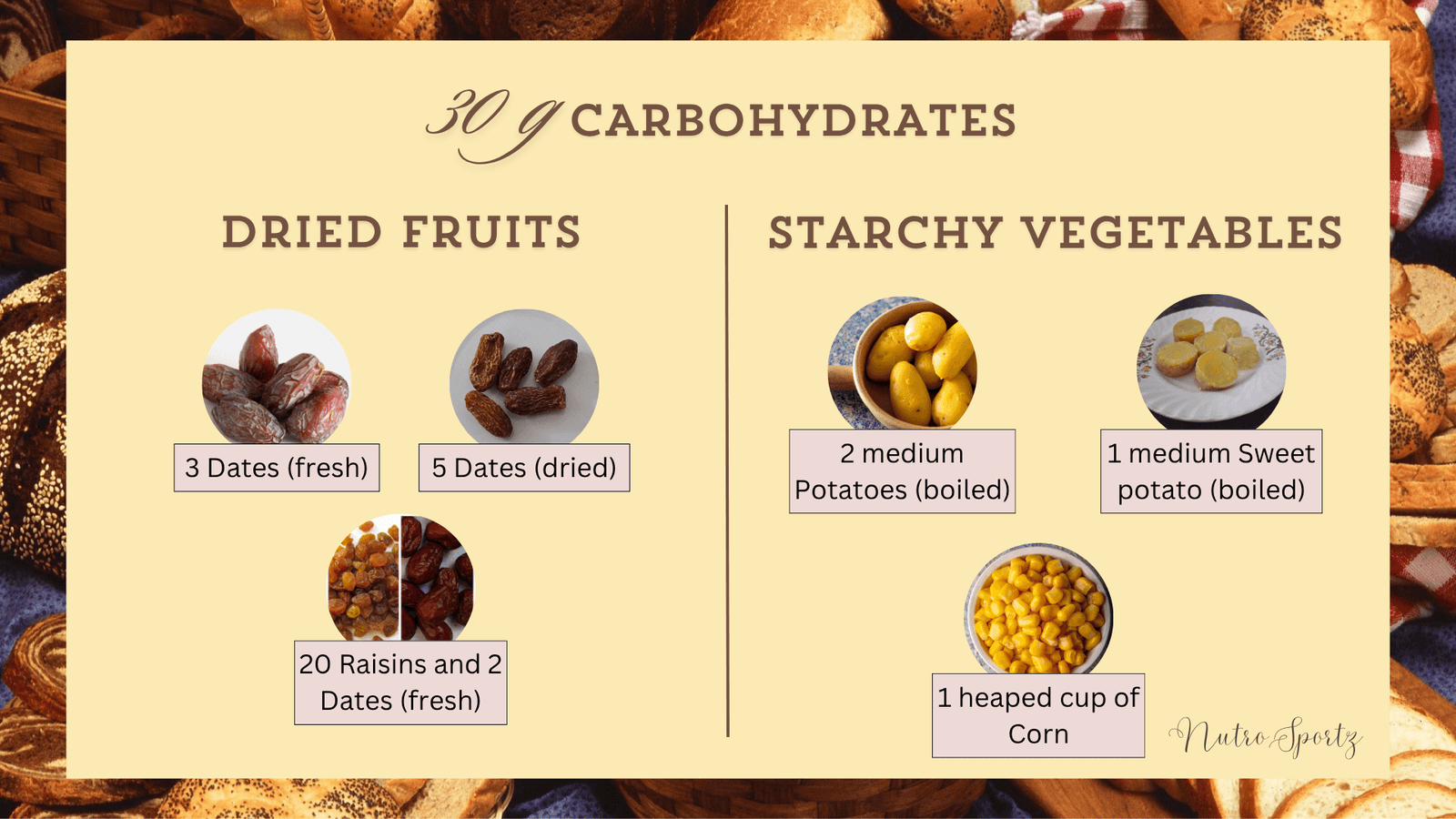
| Dates (fresh) | 45 g/ 1.6 oz | 3 no. |
| Dates (dried) | 40 g/ 1.4 oz | 5 no. |
| Raisins with dates (fresh) | 20 raisins with 2 dates | |
| Starchy vegetables | ||
| Potato (medium, boiled) | 200 g/ 7.1 oz | 2 no. |
| Sweet potato (medium, boiled) | 130 g/ 4.6 oz | 1 no. |
| Sweet corn (boiled) | 180 g/ 6.3 oz | 1 heaped cup |
| Fruits | ||
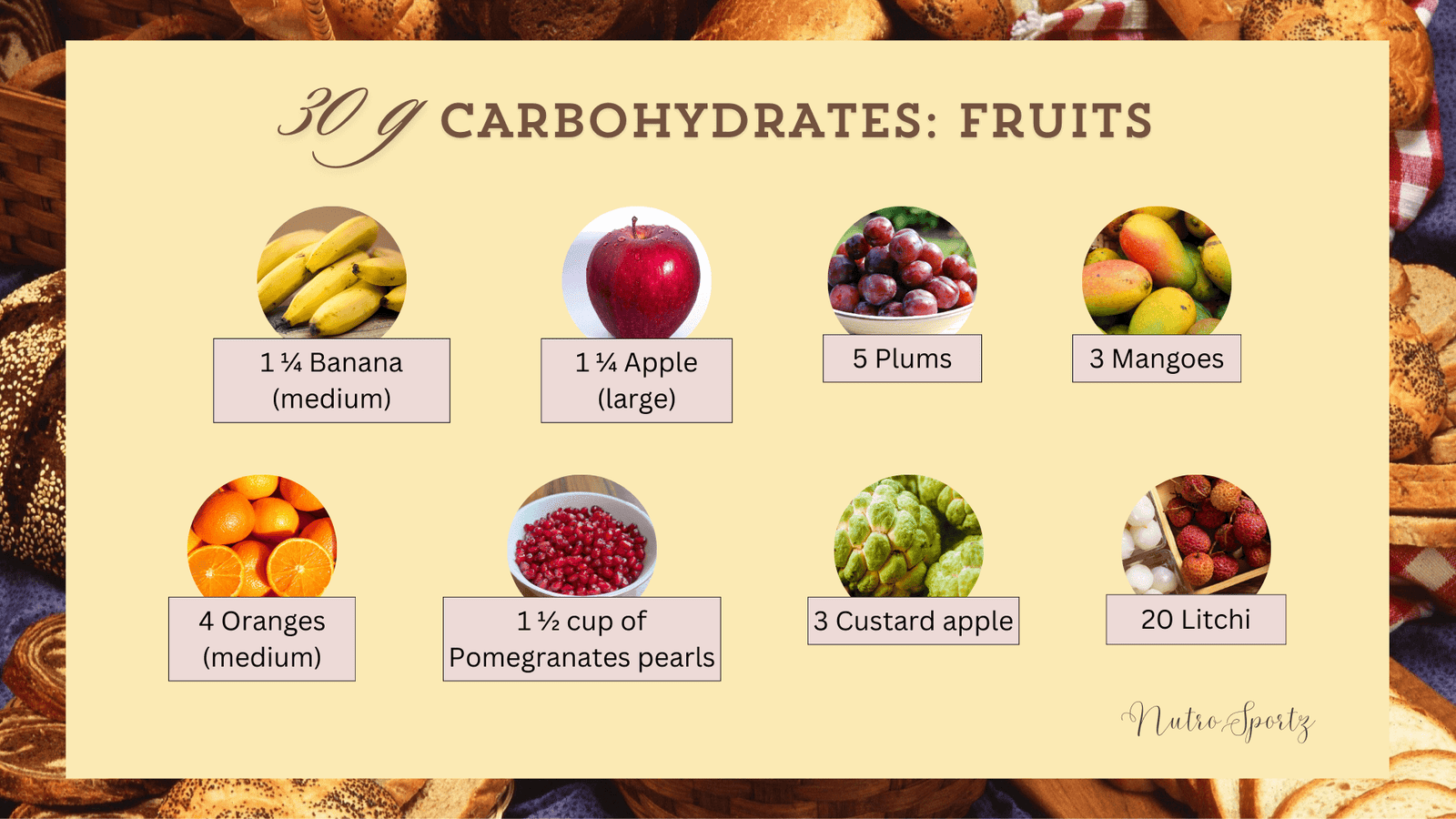
| Banana (medium) | 130 g/ 4.6 oz | 1 ¼ no. |
| Apple (large) | 230 g/ 8.1 oz | 1 ¼ no. |
| Plums | 250 g/ 8.8 oz | 5 no. |
| Mango | 300 g/ 10.6 oz pulp | 3 no. |
| Orange (medium) | 390 g/ 13.8 oz | 4 no. |
| Pomegranate | 260 g/ 9.2 oz pearls | 1 ½ cups |
| Custard apple | 150 g/ 5.3 oz pulp | 3 no. |
| Litchi | 260 g/ 9.2 oz | 20 no. |
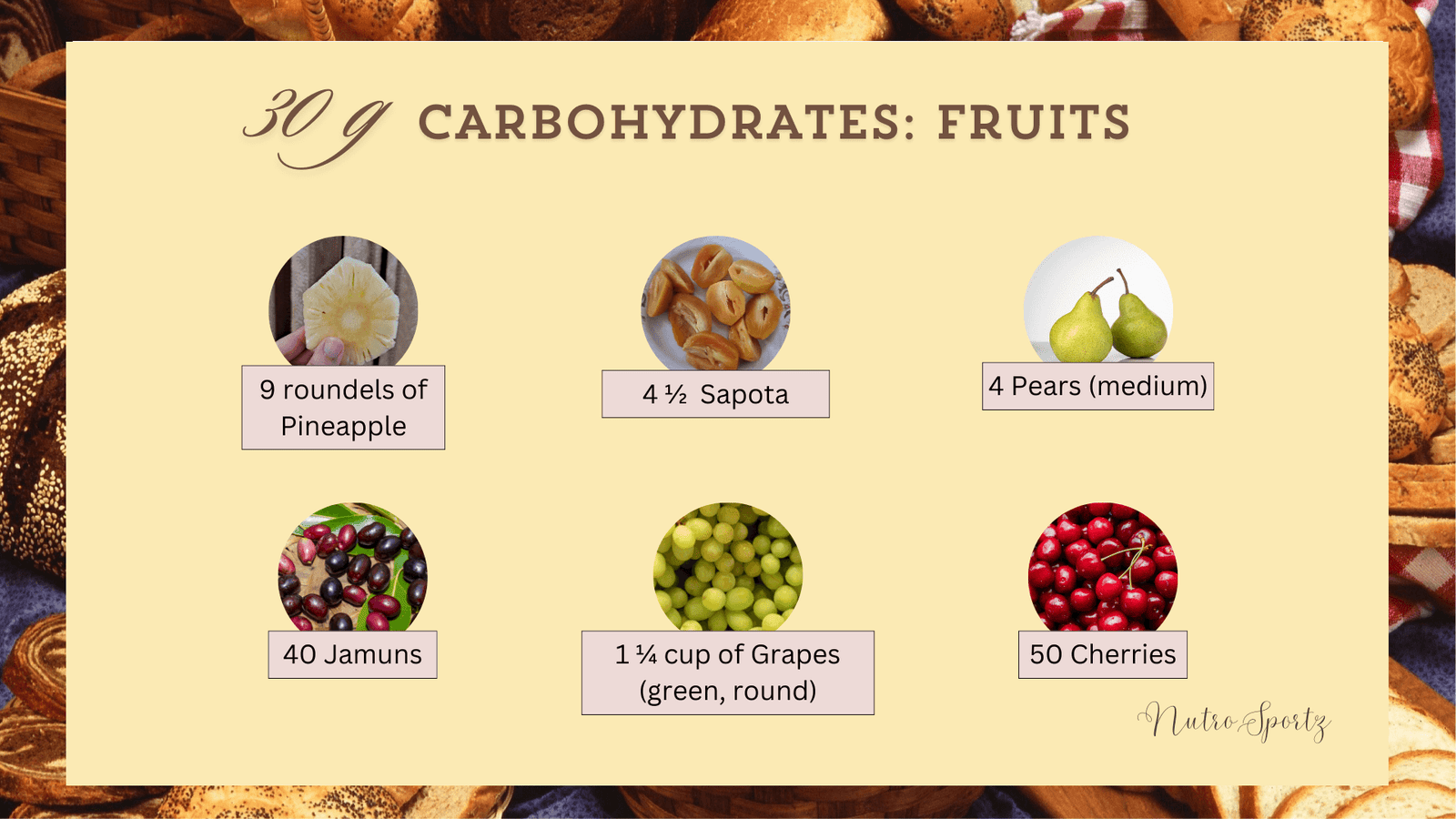
| Pineapple | 320 g/ 11.3 oz | 9 roundels |
| Sapota | 220 g/ 7.8 oz | 4 ½ no. |
| Pear (medium) | 380 g/ 13.4 oz | 4 no. |
| Jamun | 290 g/ 10.2 oz | 40 no. |
| Grapes (green, round) | 260 g/ 9.2 oz | 1 ¼ cup |
| Cherries | 260 g/ 9.2 oz | 50 no. |
| Packaged & baked foods | ||
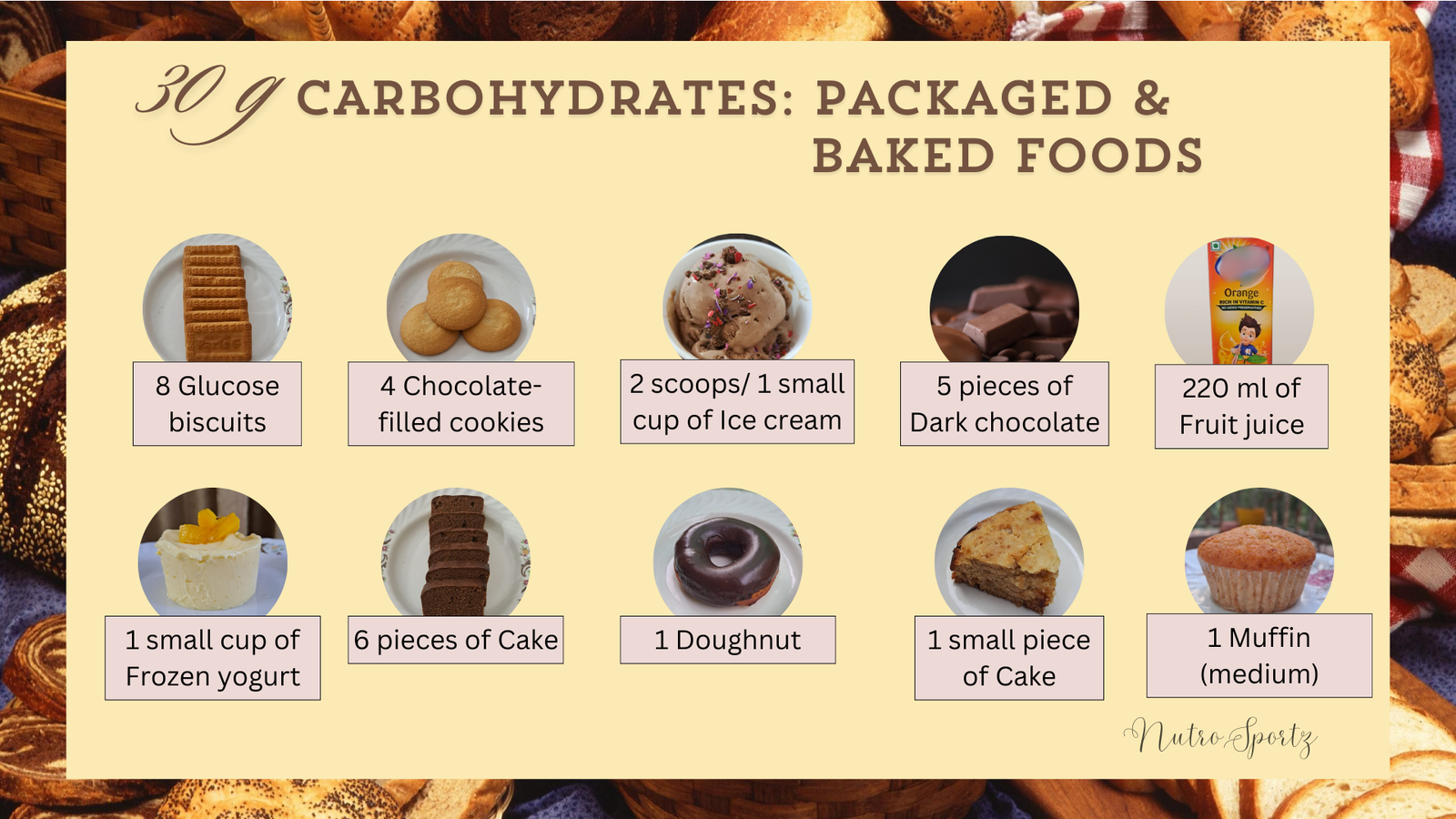
| Glucose biscuits | 40 g/ 1.4 oz | 8 no. |
| Chocolate-filled cookies | 48 g/ 1.7 oz | 4 no. |
| Ice cream | 80 g/ 2.8 oz | 2 scoops/ 1 small cup |
| Dark chocolate | Each piece of 10 g/ 0.4 oz | 5 pieces |
| Fruit juice (packed) | 220 ml | 1 small bottle |
| Frozen yogurt | 138 g/ 4.86 oz | 1 small cup of 130 ml |
| Cake slice | Each piece of 10 g/ 0.4 oz | 6 pieces |
| Doughnut | 57 g/ 2.0 oz | 1 no. |
| Cake | 70 g/ 2.5 oz | 1 small piece |
| Muffin (medium) | 50 g/ 1.8 oz | 1 no. |
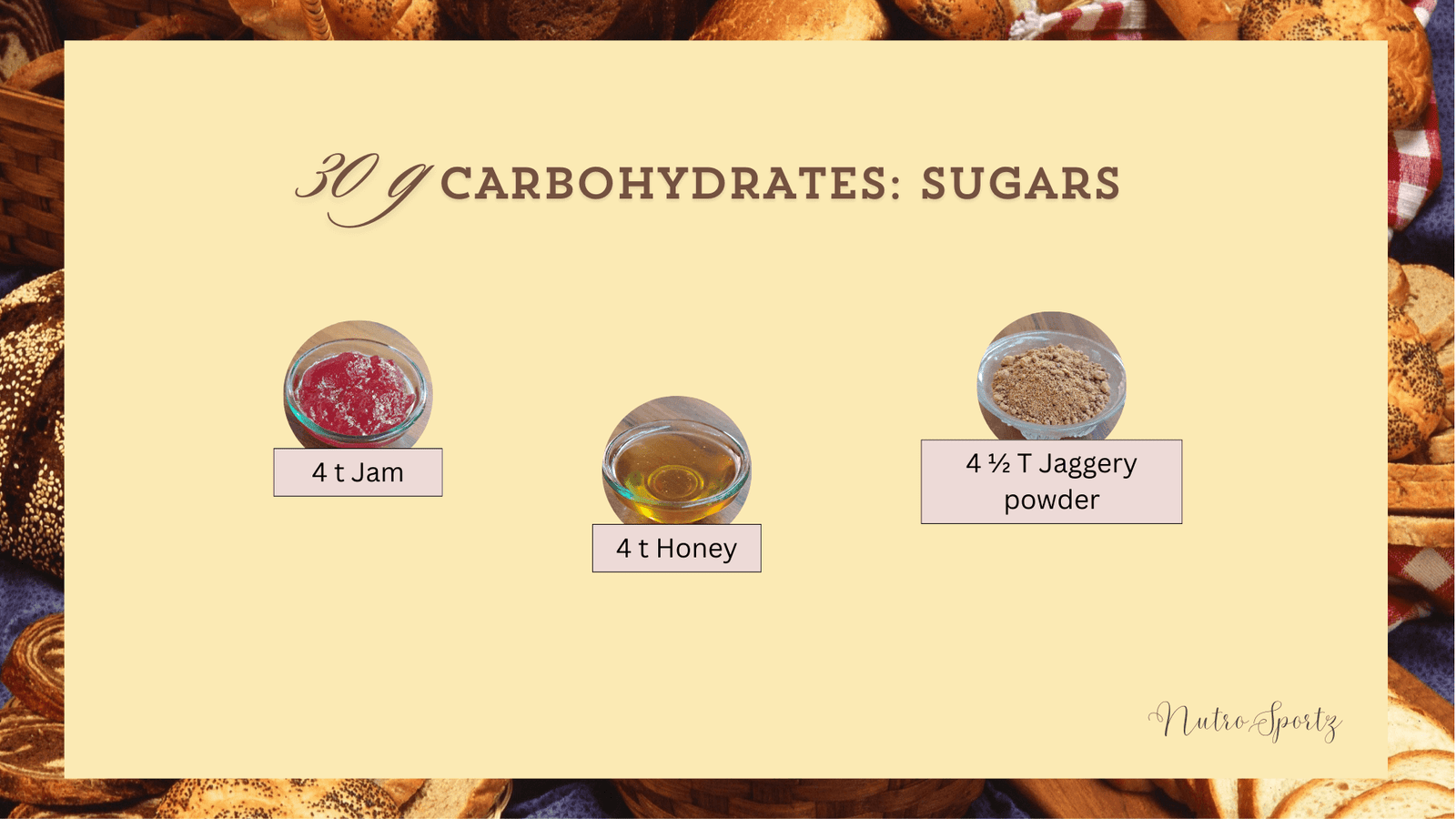
| Sugars | ||
| Jam | 40 g/ 1.4 oz | 4 t |
| Honey | 40 g/ 1.4 oz | 4 t |
| Jaggery powder | 36 g/ 1.3 oz | 4 ½ T |
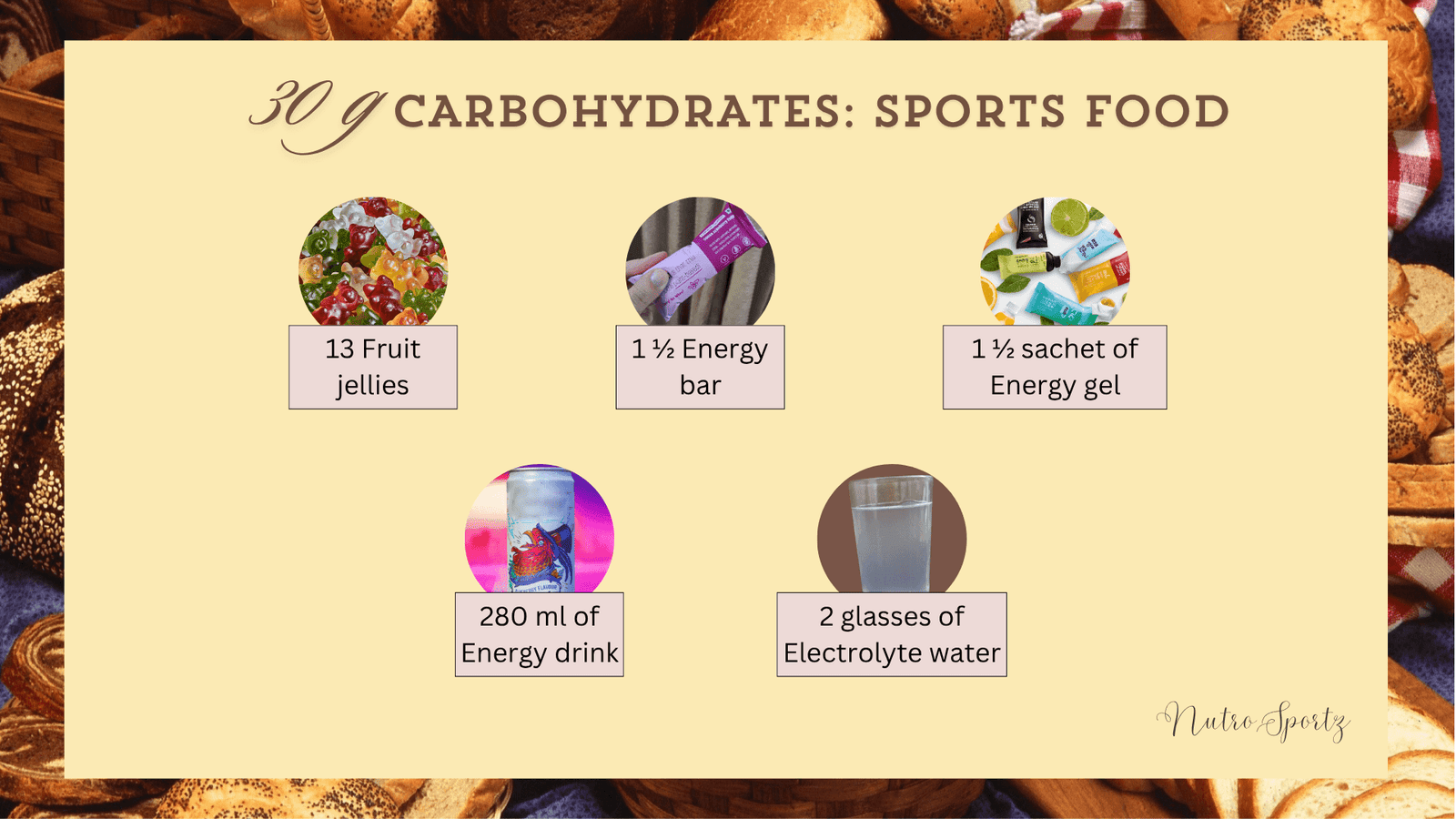
| Sports food | ||
| Fruit jelly | Each jelly of 2.7 g/ 0.09 oz | 13 no. |
| Energy bar | Each bar of 38 g/ 1.3 oz | 1 ½ no. |
| Energy gel | Each sachet of 30 g/ 1.05 oz | 1 ½ sachet |
| Energy drink | 280 ml | 1 small bottle |
| Electrolyte water (Isotonic) | Each glass of 250 ml | 2 glasses (500 ml water, 2 packs of Electral; each pack of 21.8 g/ 0.8 oz) |
Some Pointers
- Food portion sizes are approximate. It is completely okay if you eat a little less or more.
- The weight of fruits and other foods listed in the table refers to the edible portion.
- The portion sizes for some foods (like fruits, baked, and packaged foods) mentioned in the table are not required to be consumed in one day. Always aim for a balanced diet.
- When choosing a portion size for baked and packaged foods or white sauce pasta, consider the fat content as well, not just the carbohydrates.
- Remember that store-bought juices have added sugars and a minimal amount of fruit. Always choose fresh over packaged.
- Pay attention to the caffeine levels in energy drinks and gels.
- Keep in mind that energy bars often have supplements.
- Read the nutrition labels of packaged foods to know their carbohydrate content and portion size.
- The cups, teaspoons, and tablespoons mentioned in the table are measured level, not heaping.
images of measured Portions of food
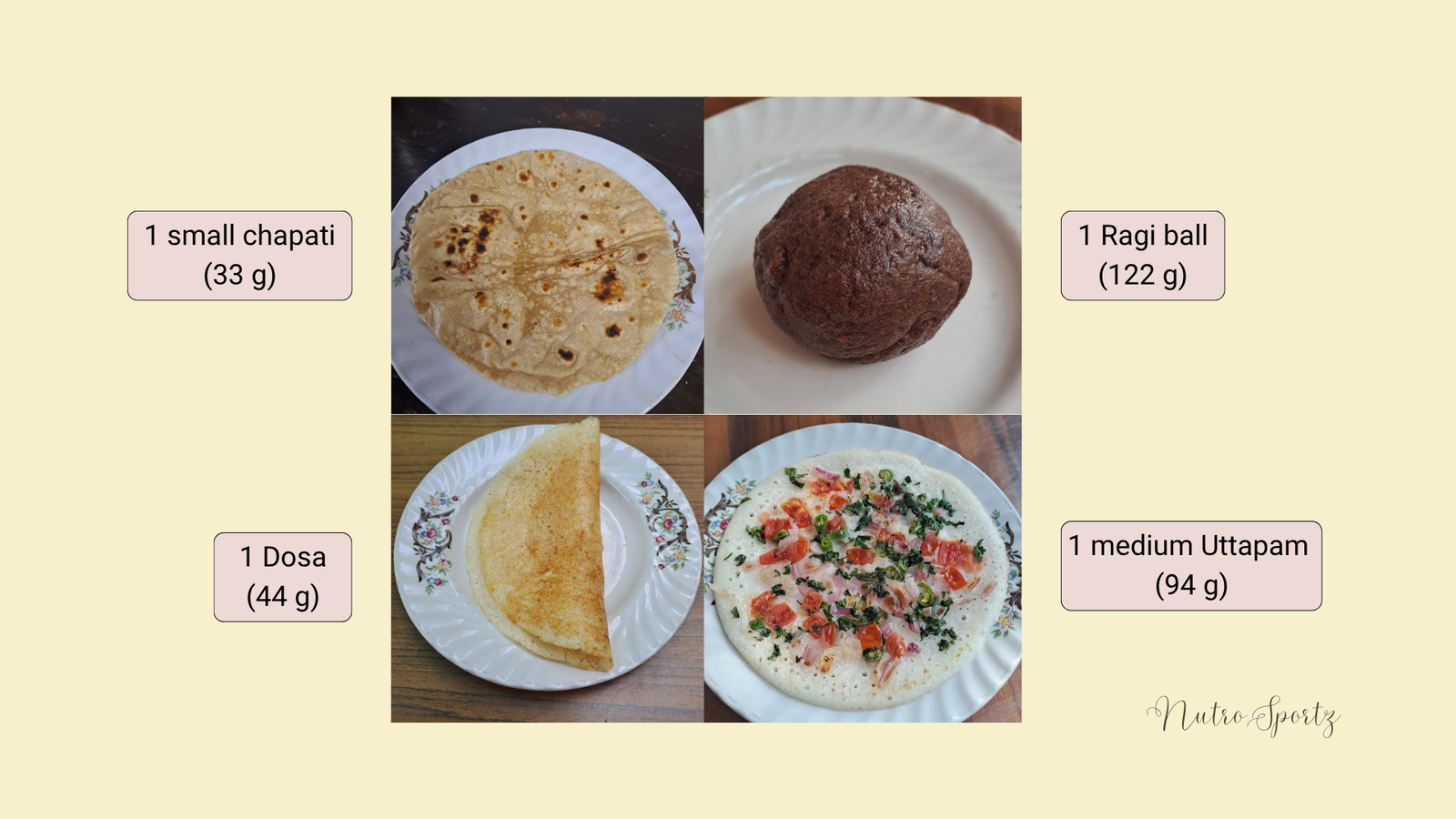
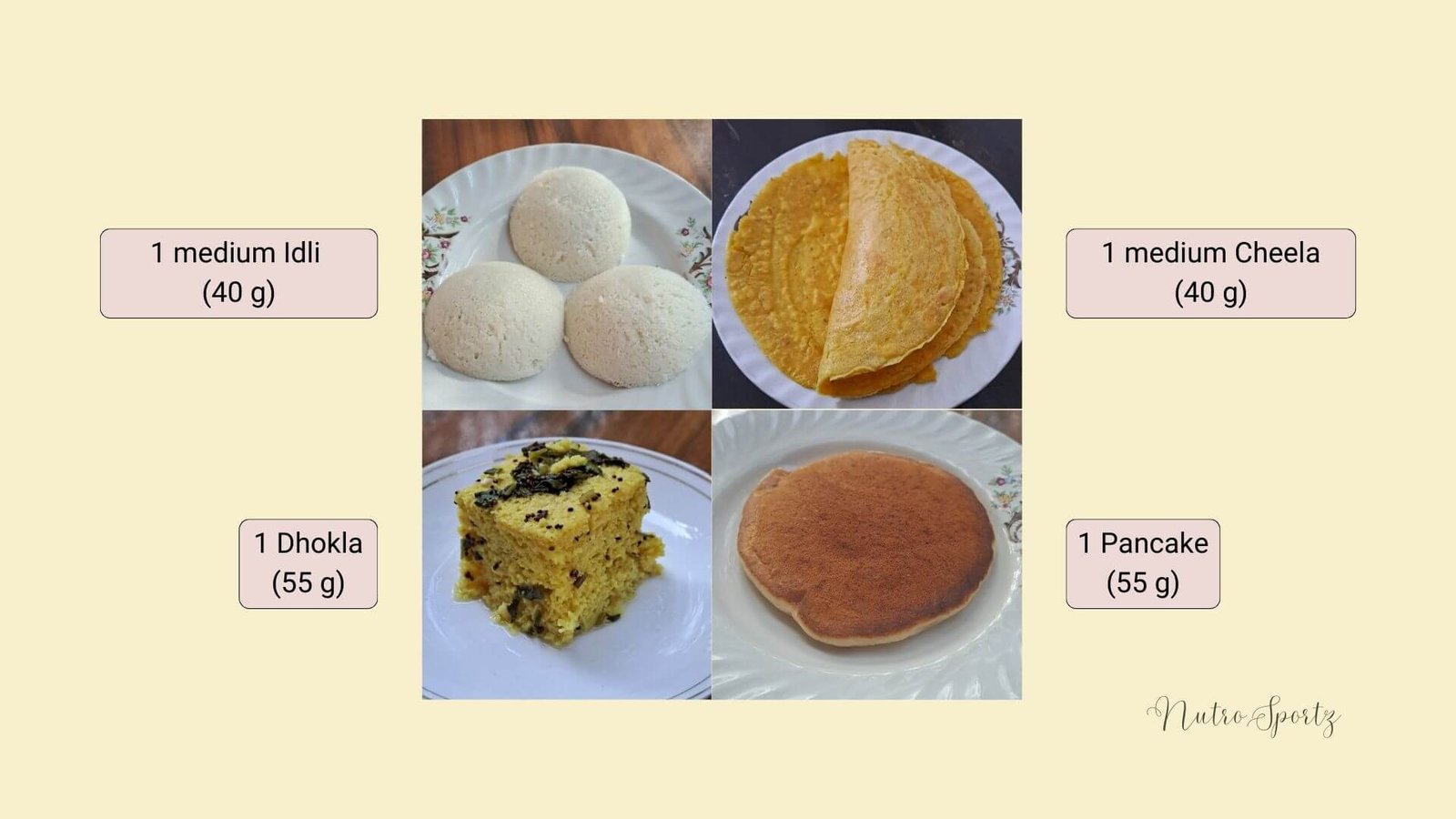
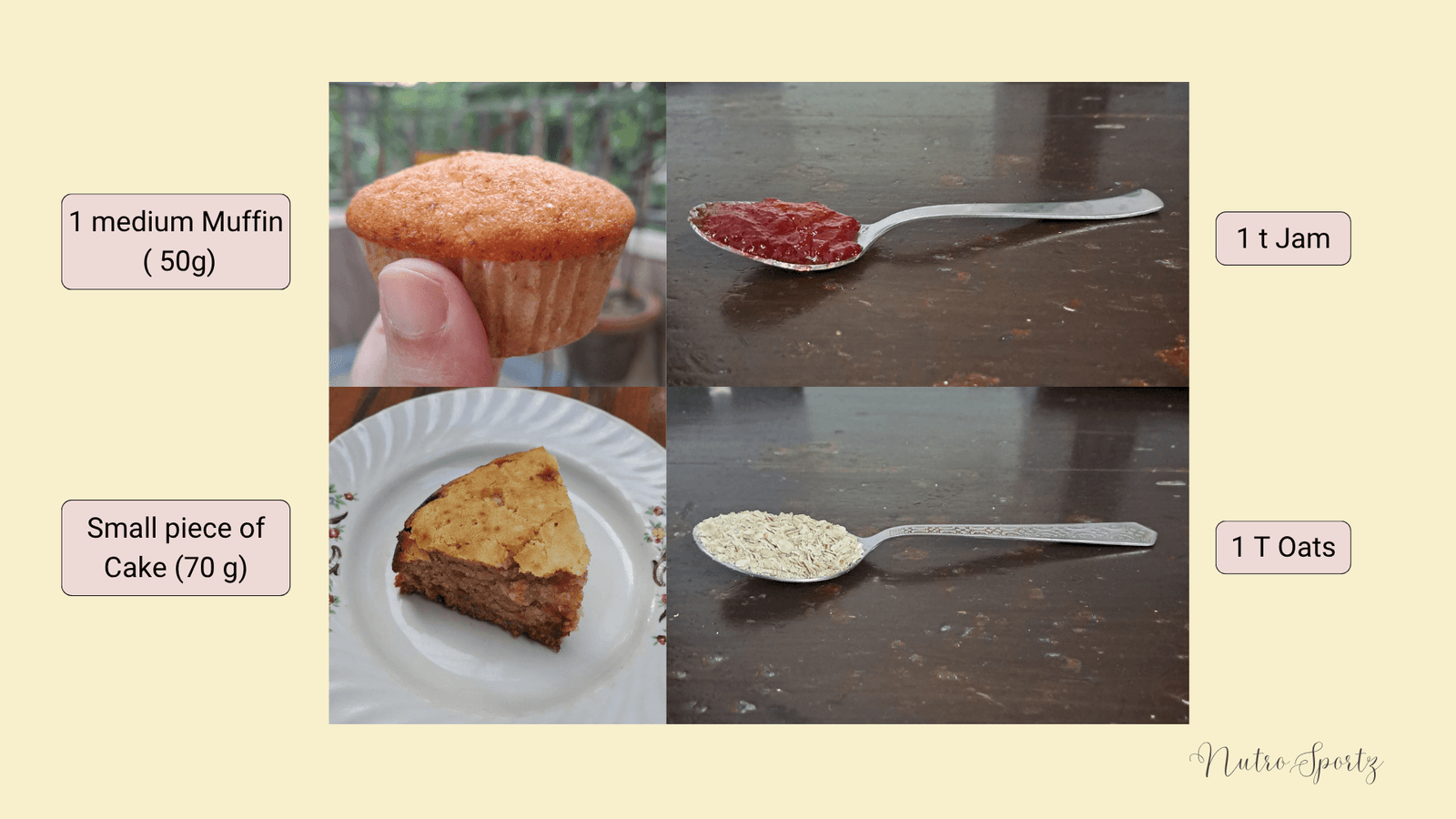
infographics of portion size of foods containing 30 grams of carbohydrates
Portioning Tips & Tools
It must be overwhelming for you to portion your food accurately while juggling training and busy schedules. However, with a few simple tools and tips, you can easily measure the amount of food you need to get 30 grams or more of carbohydrates for each meal or snack depending on the requirement.
Here are few simple ways to help you portion your food accurately:
- Use a Food Scale
- Measuring Cups and Spoons
- Smart Label Reading
tools i’ve used for measuring portions of food
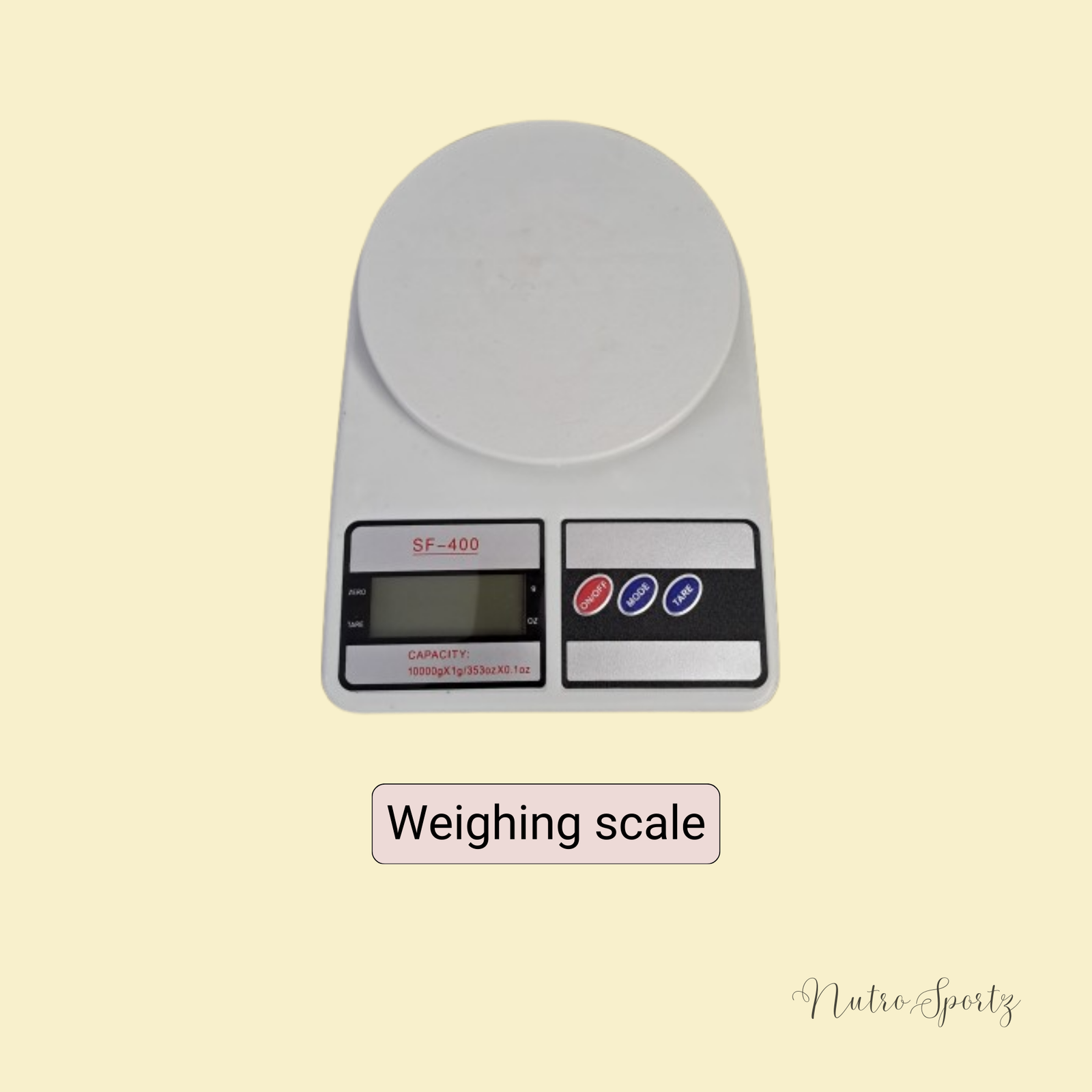

I’ve gone into detail about each one of these techniques in my post, “Know The Difference: Serving, Serving Size, And Portion Size”.
How to alter the carbohydrate content of meals when the requirement is more?
By now, you should have an idea of how much food is required to reach 30 grams of carbohydrates. But you may be wondering how you can alter the carbohydrate content of your meal when you need more than 30 grams.
Let me walk you through the process, step by step.
1. Choose a carbohydrate-containing food
To adjust the carbohydrate content of a meal to meet your daily requirement, start by choosing carbohydrate-containing foods. Refer to the table for a list of sources.
2. Check the portion size of foods
Understanding the right portion sizes helps you plan your meals quickly. Check out the table or infographics to easily find the portion sizes for different carbohydrate-containing foods.
3. Write down the portion size and carbohydrate content for each food item
Note the portion size and carbohydrate content of each food you choose.
4. Sum up the carbohydrate contents
To calculate the total carbohydrates in your meal, simply add up the carbohydrate content of each food item you include.
5. Check if the total amount meets the requirement
Once you’ve added everything up, you might find that the total carbohydrate content is either above or below your requirement. No need to worry—just adjust the portion sizes (increase or decrease) accordingly. It’s that simple, right?
Take A Look At Step-by-step Example: How To Alter The Carbohydrate Content Of Meals
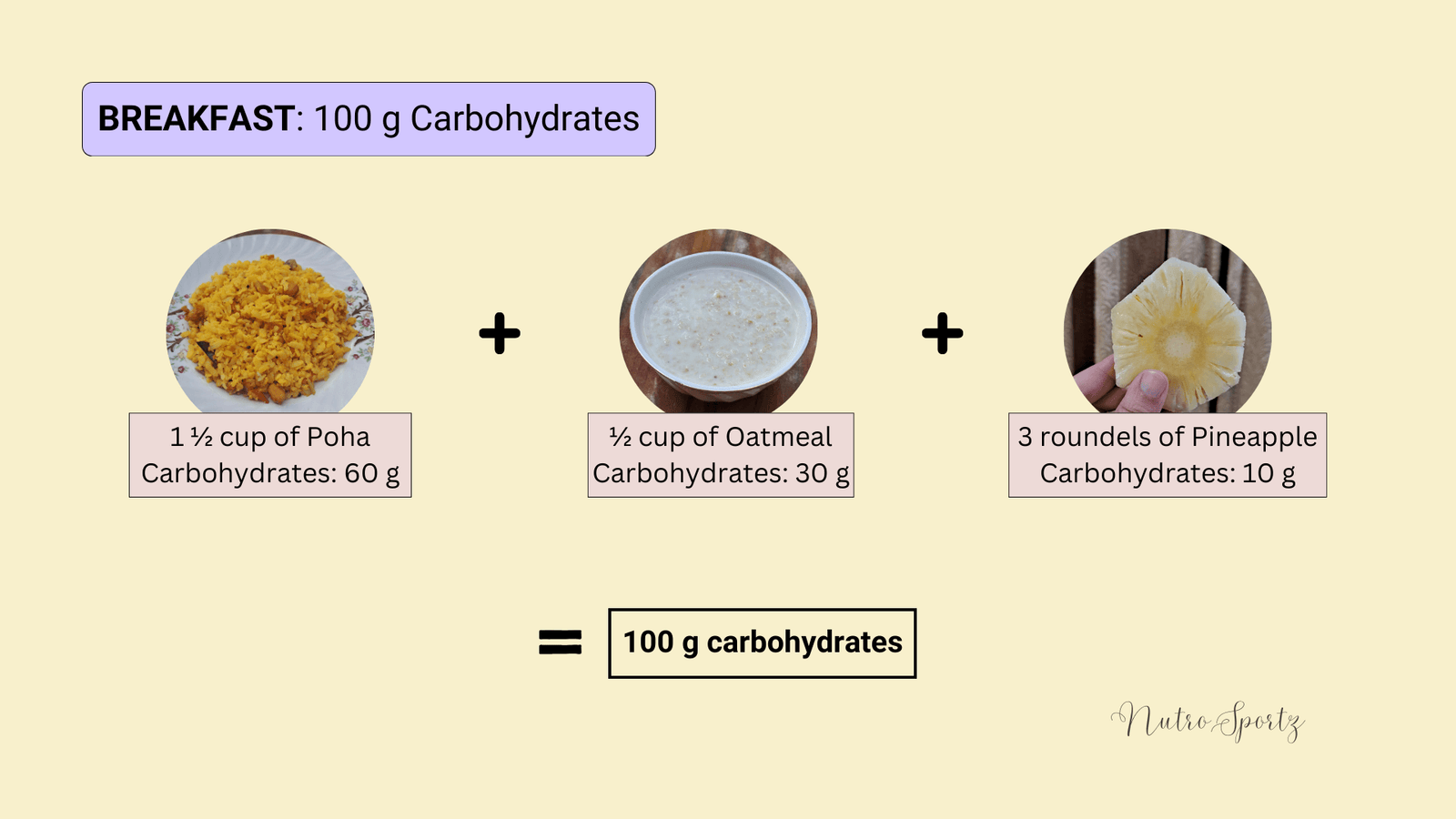
Let’s say you need to consume 100 grams of carbohydrates for breakfast. What will you do first?
You decide on a breakfast that includes poha, oatmeal, and pineapple. Now, it’s time to check the portion sizes for each food item in the table or infographic. Upon review, you find ¾ cup of poha, 9 roundels of pineapple, and ½ cup of oatmeal, each containing 30 grams of carbohydrates.
Let’s break it down how to adjust the portion sizes:
- If ¾ cup of poha contains 30 grams of carbohydrates, then 1 ½ cups of poha would give you 60 grams of carbohydrates.
- Similarly, if 9 roundels of pineapple provide 30 grams of carbohydrates, 3 roundels would give you 10 grams.
- Lastly, ½ cup of oatmeal contains 30 grams of carbohydrates- perfect as is.
Now, simply add up the carbohydrate content of all the foods you’ve chosen, and you’ll have the total amount your meal gives.
Total amount of carbohydrates= 60 g (1 ½ cup poha) + 30 g (½ cup oatmeal) + 10 g (3 roundels of pineapple)
= 100 g
Woohoo! You met the requirements👏 .
Your breakfast is all set and ready to fuel your day💪.
For recipes that provide 30 grams of carbohydrates (approx.), check out my recipes for:
- Eggless banana oats pancake
- Easy poha recipe
- Seviyan upma
- Quinoa chickpea salad
- Healthy avocado toast
- Eggless blueberry oats muffins
- High-protein green wrap
- Moong dal dhokla with green yogurt dip
Final thoughts
Getting the right amount of carbohydrates does not have to be complicated! By now, you know how to portion your food to hit that 30-gram goal and how to adjust it when the requirement is more.
Whether you’re grabbing a snack or planning a meal, these simple tips will help keep you energized⚡ and ready to tackle your next workout🏃♂️. Don’t sweat it- just keep things simple and stay consistent.
Want to learn about carbohydrates from start to finish? Check out my complete guide here: “Carbohydrates: A Complete Guide to the Body’s Fuel“
Oh, and if you liked this post, you’ll love this one: “Know How To Get 10 Grams Of Protein From Foods“
frequently asked questions
Why is 30 grams of carbohydrates important?
30 grams of carbohydrates is a commonly used unit for fuelling workouts or recovery. It provides a practical way to plan meals and snacks around performance needs.
Do all carbohydrate foods provide the same amount per portion?
No. Different foods require different portion sizes to provide 30 grams of carbohydrates. For example, ¾ cup rice or 2 small chapatis may both provide ~30 grams of carbs.
What are some common foods that provide carbohydrates?
Bread, chapati, pulses & legumes, starchy vegetables, fruits, dried fruits, honey, jam, cakes, and ice cream are examples of common foods that provide carbohydrates.
What are the examples of 30 grams of carbohydrates?
2 slices of bread, ¾ cup of rice, ½ cup of oatmeal, 3 fresh dates, 2 medium-sized potatoes (boiled), 1 ¼ banana, and 2 small muffins are some examples that provide 30 grams of carbohydrates.
How do I adjust my meal if I need more than 30 g carbohydrates?
Simply increase portion sizes or combine multiple carbohydrate sources. For example, doubling a portion gives ~60 g carbohydrates.
How can athletes use this 30-Gram-Of-Carbohydrates concept?
Athletes can use it to: plan pre-workout fuel and recovery meals, and adjust intake based on training intensity.
Is it okay if my portion is slightly more or less than mentioned amount in table?
Yes. Portion sizes are approximate, and small variations are completely normal and acceptable.
Are packaged and processed foods good sources of carbohydrates?
They can provide carbohydrates, but often contain added sugars and fats. It is better to prioritize whole foods and use packaged options mindfully.
References
- Gopalan, C., Rama Sastri, B.V., Balasubramanian, S.C. (2018). Nutritive value of Indian foods. National Institute of Nutrition.
- Longvah, T., Ananthan, R., Bhaskarachary, K., Venkaiah, K. (2017). Longvah, T. (Ed). Indian food composition tables. National Institute of Nutrition.
Time to wrap up
Next time you’re serving your meal, give these tips a try and let me know how it goes in the comments below.